 By Saurav Mehra
 Two of India’s most celebrated names in literature and cartooning were both born on this quiet Purasawalkam street. R.K. Narayan, one of the founding figures of Indian writing in English, and his younger brother R.K. Laxman, creator of the beloved “Common Man” cartoon for the Times of India, were both born at Number 1, Vellala Street. It’s a detail most people walking past today wouldn’t guess, given how unassuming the street itself remains — a narrow, one-way residential lane that’s changed considerably since those literary beginnings.
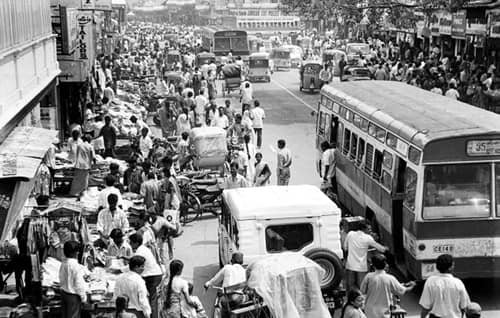
A Street Named After a Community, With a Deeper Literary History
Vellala Street, also commonly called Vellalar Street, is popularly believed to take its name from the Vellalar community, whose early residents supposedly gave the street its identity — though according to a detailed local account published in Madras Musings, the street’s technically correct name is actually Vinaitheertha Vinayakar Koil Street, a name traceable through decades-old records from the Purasawalkam Permanent Fund Limited, a nidhi founded by Sri M. Appadurai Pillai. The “Vellala Street” name that stuck in common use may itself be a popular simplification rather than the street’s original title.
R.K. Narayan (born Rasipuram Krishnaswami Narayanaswami) was born at the then-numbered House No. 1 on this street, with door numbers historically starting from the southern end. His first cousin, T.S. Sridhar — known by the pen names Marina and Bharanidaran, associated with Ananda Vikatan magazine — was also born in the same house, and Narayan’s younger brother R.K. Laxman followed. Both Narayan and Sridhar attended early classes at the nearby E.L.M. Fabricius School on Purasawalkam High Road. The street’s literary lineage didn’t stop there either — the Tamil humour writer Makaram lived just a door or two away, and towards the street’s western end lived another popular Tamil humourist, [Gomathi] Swaminathan.
Vellala Street at a Glance
| Category | Details |
| Also known as | Vellalar Street; technically Vinaitheertha Vinayakar Koil Street |
| Location | Purasawalkam, Chennai |
| Pin code | 600084 |
| Postal head office | Purasawalkam |
| Nearest bus stops | Purasawalkam, Purasawalkkam, Megala — all under 10 min walk |
| Nearest metro | Nehru Park Metro — approx. 31 min walk |
| Metro lines nearby | Green Line, Inter-Corridor |
| Nearest railway station | Chennai Egmore — approx. 36 min walk |
| Notable residents | R.K. Narayan, R.K. Laxman (both born at No. 1) |
| Key temples | Karpaga Vinayagar Temple, Srinivasa Perumal Temple |
| Local landmarks | Meena Typing Institute, Corporation School, Muthu Pharmacy |
| Street character | Changed from quiet bylane to noisy one-way lane over the years |
| Nearby attractions | Abhirami Mega Mall (site), Government Museum, Alsa Mall, St Andrew’s Church |
Where Vellala Street Sits
Vellala Street runs through Purasawalkam, a well-established central Chennai neighbourhood known for its dense residential lanes and long-standing local commerce. It sits within the Purasaiwakkam locality, close to Lumbini Square, Kellys, and B Block, and near some of the area’s better-known landmarks, including the site of the former Abhirami Mega Mall, the Government Museum, Alsa Mall, and St Andrew’s Church, several of which are within an easy walk.
Getting to Vellala Street
Purasawalkam and Purasawalkkam bus stops sit closest, both roughly five-to-six minutes’ walk away, with Megala a further seven-minute walk and Motcham about nine minutes. Bus lines including 159A, 23C, 27D, 29C, and T29 all stop nearby, making local bus travel genuinely the most straightforward way to reach the street for most Chennai residents.
Chennai Metro’s Green Line and Inter-Corridor lines both serve the wider area, but Nehru Park Metro station is the nearest stop and it’s a genuine 31-minute walk — first metro at 4:58 AM, last at 12:13 AM — so most visitors combine it with an auto or short cab ride for the final stretch rather than walking the whole distance. Chennai Egmore railway station sits further out still, roughly 36 minutes on foot.
- Bus: Purasawalkam/Purasawalkkam stops, under 6 minutes away; routes 159A, 23C, 27D, 29C, T29
- Metro: Nehru Park (Green Line/Inter-Corridor), about 31 minutes on foot
- Rail: Chennai Egmore, roughly 36 minutes on foot
- Auto/cab: Widely available and generally the easiest way to cover the final stretch from either the metro or Egmore station
Purasawalkam’s narrow residential lanes mean walking is often the most practical way to actually move around once you’re in the immediate area, even if you arrive by a faster mode of transport.
What’s on the Street: Temples, Shops, and What Remains
Vellala Street itself is primarily residential, so the shopping and commercial energy associated with a visit here really comes from its surroundings and its own small local fixtures. Two notable temples anchor the street’s religious character: the Karpaga Vinayagar Temple and the Srinivasa Perumal Temple, the latter specifically noted as a landmark that has endured even as the rest of the street’s character shifted from a quiet bylane to a busier one-way lane over the decades. A handful of everyday establishments round out the street’s local commerce — the Meena Typing Institute, a Corporation School, regular department stores, and Muthu Pharmacy among them, giving the lane the practical, lived-in feel typical of an older Chennai residential street rather than any retail destination in its own right.
The street’s real draw for most visitors isn’t shopping — it’s the literary connection. Abhirami Mega Mall, once a prominent three-floor shopping mall built in 1976 and named after owner Abirami Ramanathan, stood close by until its closure in 2019, and its former site remains a commonly cited landmark for orientation purposes even today.
Nearby Areas Worth Visiting Together
Abhirami Mega Mall (former site), roughly an eight-minute walk away, remains a well-known reference point in the neighbourhood even though the mall itself closed in 2019.
The Government Museum, one of Chennai’s oldest and most significant museums, sits within easy reach and is worth combining into the same outing if you’re interested in the city’s cultural institutions.
Alsa Mall, another nearby retail option, adds shopping variety to the immediate area for visitors looking for a functioning mall rather than a historical landmark.
St Andrew’s Church, a historic landmark nearby, reflects Purasawalkam’s layered colonial-era architectural history alongside its residential character.
FAQs
Q1. Why is Vellala Street notable, and is the name actually correct?
It was home to R.K. Narayan and R.K. Laxman, two major figures in Indian literature and cartooning, who were both born at Number 1, Vellala Street. Interestingly, local historical records suggest the street’s technically correct name is Vinaitheertha Vinayakar Koil Street, with “Vellala Street” being the popularly used, simplified version.
Q2. Is Vellala Street a shopping destination?
Not directly — it’s a residential street with a few local establishments like a pharmacy and typing institute, though nearby Alsa Mall provides functioning retail options within easy walking distance; the former Abhirami Mega Mall closed in 2019 but remains a landmark reference point.
Q3. How do I reach Vellala Street by public transport, and what’s the fastest option?
Local buses are genuinely the quickest option, with Purasawalkam and Purasawalkkam stops just five-to-six minutes’ walk away on routes including 159A, 23C, 27D, and 29C. The nearest metro station, Nehru Park, is a much longer 31-minute walk, so it’s best combined with a short auto ride for the final stretch.
Q4. Is there more than one Vellala Street in Chennai?
Yes — the name appears in several other Chennai localities, including Mogappair, Vadapalani, and Ambattur, so it’s worth confirming which one you mean when searching, especially since the Purasawalkam version has a distinct literary history tied to it.