 By Saurav Mehra
 Behind the sanctum of a temple that predates British rule in Madras sits an ant hill under a banyan tree — an odd detail for a place of worship, until you learn what it means to the people who visit it. Devotees carrying what Tamil tradition calls Naga Dosha, a serpent-related affliction believed to bring misfortune, come here specifically to offer milk and eggs at that ant hill, tying a red thread to the tree above it in hope of relief. This is Mundakanni Amman Koil Street in Mylapore — a residential lane in one of Chennai’s oldest neighbourhoods, built entirely around a temple that’s been part of local life for roughly 1,300 years.
For Indian travellers and pilgrims planning a Mylapore visit, this street offers something genuinely different from the area’s more famous Kapaleeshwarar Temple circuit: a quieter, deeply local temple experience, with its own dedicated railway station and a rhythm shaped by devotees rather than tourists.
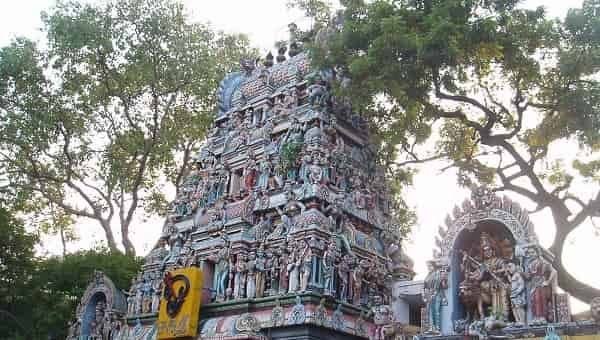
The Temple That Gave the Street Its Name
The Mundakanni Amman Temple predates the British period in Madras and was originally referred to as a “Pagoda” — one of the guarding deities of Mylapore village itself, according to local heritage records. Legend holds that a lotus pond once existed at this spot, and under a banyan tree beside it, the goddess manifested in Swayambu form — meaning self-created, not crafted by human hands. Because her form resembles a lotus bud, she came to be called Mundaka Kanni Amman (“Mundakam” meaning lotus).
What makes the temple architecturally distinctive is its deliberate simplicity. Devotees originally built a simple hut as her sanctum, and remarkably, that original thatched-roof structure remains the sanctum to this day — a conscious choice reflecting the belief that the goddess, as a nature lover, prefers staying close to natural surroundings rather than being enclosed in elaborate stonework. The temple’s Rajagopuram (tower) and side entrance arch were only added in 1979, funded through donations, with further additions like stone paving in 1982, a Pongal mandapam in 1985, and marble flooring in 1997.
Mundakanni Amman is considered a form of Goddess Saraswati, blessing devotees with wisdom in fine arts and learning — which is why many Mylapore families bring children here before starting formal education. She’s also linked to ancient Kottravai worship, a tradition dating back to the era of Tholkappiam and Silapathikaram, two of the oldest works in Tamil literature. Tradition also holds that two revered saints, Vayilar (a Nayanmar) and Peyalvar (an Alvar), were born at this very site — a detail that adds considerable weight to the temple’s standing among Mylapore’s older residents.
Mundakanni Amman Koil Street Quick Overview
| Category | Details |
| Location | Mylapore, Chennai (near Luz-Santhome Road) |
| Temple age | Approx. 1,300 years old |
| Deity | Mundakanni Amman (form of Saraswati / Renukadevi) |
| Deity form | Swayambu (self-manifested), lotus-bud shaped |
| Sanctum roof | Original thatched structure, preserved deliberately |
| Nearest MRTS station | Mundagakanniamman Koil — approx. 500 m |
| Alternate MRTS station | Thirumayilai — approx. 1 km |
| Nearest metro | Thirumayilai (Beach–Velachery corridor) |
| Distance from Chennai Central | Approx. 8 km |
| Key associated relief | Naga Dosha (serpent affliction), chicken pox (via theertham) |
| Auspicious days | Tuesdays and Fridays |
| Busiest period | Tamil month of Aadi (July–August) |
| Special rituals | Anna Abishekam (rice anointment), 1008-lamp feast, milk pot procession |
| Related nearby temples | Nagathamman Temple, Angala Parameswari Amman Temple (same street) |
| Administered by | Hindu Religious and Charitable Endowments Dept., Tamil Nadu |
Where the Street Sits and How to Reach It
Mundakanni Amman Koil Street runs through Mylapore, one of Chennai’s oldest and most culturally significant neighbourhoods, with settlement history stretching back over two millennia. The street sits close to Brindavan Street and runs near the Buckingham Canal, in the northern part of Mylapore bordering Santhome and Royapettah.
This is one of the more conveniently connected temple streets in the city, largely because it has its own dedicated station. Mundagakanniamman Koil MRTS station, an elevated station on the Chennai Beach–Velachery line, opened in 2014 as the network’s 18th operational MRTS stop — and it sits roughly 500 metres from the temple, an easy seven-to-eight-minute walk.
For those arriving from elsewhere in the city:
- MRTS/Rail: Thirumayilai MRTS station is a further alternative, about a kilometre away, while Chennai Central, the city’s main railway junction, sits roughly 8 km out — a comfortable auto or cab ride.
- Metro: Thirumayilai also serves as the nearest Chennai Metro connection point on the Beach–Velachery corridor, useful for travellers combining a temple visit with other parts of the city.
- Bus: Regular MTC buses run to Mylapore Tank and Luz Corner from virtually every part of Chennai, both within easy walking distance of the street.
- Road: Auto-rickshaws and cabs reach the area easily via Luz-Santhome Road, from where a signposted arch marks the route into the temple street itself.
Given Mylapore’s narrow lanes and the genuine crowding that builds up during festival periods, walking the final stretch — regardless of how you arrive — tends to be more practical than trying to drive directly up to the temple entrance.
What Happens on the Street: Rituals, Timings, and Shops
The street’s rhythm is dictated almost entirely by temple activity rather than commerce. Tuesdays and Fridays are considered especially auspicious for Amman worship here, and residents of Mylapore have a long-standing custom of offering abhisheka to this goddess before performing any major ritual in their own homes — a sign of how central she is to the neighbourhood’s everyday religious life, even ahead of the more famous Kapaleeshwarar Temple nearby.
A few specific practices set this temple apart. The theertham (holy water) here is locally believed to help relieve chicken pox, a belief that draws visitors seeking this specific remedy even from outside Mylapore. Rice anointment, or Anna Abishekam — typically reserved for Shiva lingams elsewhere — is performed here for the goddess for a fee of around ₹120, and only during this ritual does she appear in her natural Swayambu form. During August and September, the temple distributes porridge (kool) and sweet pudding (Pongal) to devotees, along with sacred milk believed to carry protective properties. The last Friday of August sees a tribute of 1,008 flowers, while the last Friday of September brings a 108-lamp feast — both drawing considerably larger crowds than an ordinary weekday visit.
Commerce on the street exists almost entirely to support this temple economy. Small shops near the entrance sell milk packets, flowers, turmeric, and eggs — the standard offerings devotees bring for puja — sourced fresh rather than packaged, in the way most working South Indian temple streets operate. Beyond that, the lane carries the everyday texture of a Mylapore residential street: small provision stores and a few local eateries, nothing built for tourist footfall.
Two other notable shrines share the same street. The Nagathamman Temple, dedicated to a village deity associated with serpent worship, sits just behind the Sri Madhava Perumal Temple on this lane, while the Sri Angala Parameswari Amman Temple — reportedly over a century old by British-era records, from a time when the area was inhabited by fishing communities — sits nearby as well, making this a genuine cluster of village-deity worship rather than a single-temple destination.
Nearby Areas Worth Visiting Together
Kapaleeshwarar Temple, one of Chennai’s most iconic Shiva temples, anchors the wider Mylapore temple circuit and combines naturally with a visit here.
Mylapore Tank, the temple tank associated with Kapaleeshwarar, is a well-known local landmark and a natural stop on any temple-focused walk through the neighbourhood.
Luz Church, one of the oldest churches in Chennai, reflects Mylapore’s layered religious history running alongside its Hindu temple traditions.
Santhome, close by, adds its own cathedral and seafront to a day spent exploring Mylapore’s spiritual and cultural landmarks.
FAQs
Q1. Is this the same temple people mean when they say “Mundaka Kanni Amman Temple” or “Mundakanniamman”?
Yes — spellings vary across sources (Mundakanni, Mundaka Kanni, Mundagakanni), but they all refer to the same roughly 1,300-year-old temple on this street, dedicated to the same Swayambu form of the goddess.
Q2. What should I bring if I’m visiting specifically for Naga Dosha relief?
Milk and eggs are the traditional offerings made at the ant hill and banyan tree behind the sanctum, along with a red thread tied to the tree as a symbol of the wish being made. These items are available from the small shops right outside the temple, so there’s no need to carry them from home.
Q3. How early should I arrive during the Aadi festival month to avoid heavy crowds?
Since the temple’s biggest annual rush falls during Aadi (July–August), arriving in the early morning — ideally before 8 AM — gives a noticeably calmer darshan experience than visiting later in the day, when queues build up quickly.
Q4. Can I combine a visit here with the Kapaleeshwarar Temple in a single trip?
Yes, easily. Both sit within Mylapore’s compact, walkable temple district, and most visitors cover Mundakanni Amman Koil Street, Mylapore Tank, and Kapaleeshwarar Temple in a single half-day outing without needing separate transport between them.