 By Saurav Mehra
 Every October, some part of the supply chain behind Kolkata’s thousands of Durga Puja pandals passes through Kalakar Street — the terracotta on the idols, the artificial flowers strung across the pandal, the fabric draping the mandap. Tucked into Burrabazar, India’s oldest and largest wholesale market, this narrow trading lane has spent generations as the city’s go-to source for festival materials, and it’s built enough of a general merchandise trade around that seasonal core to stay genuinely busy the other eleven months too.
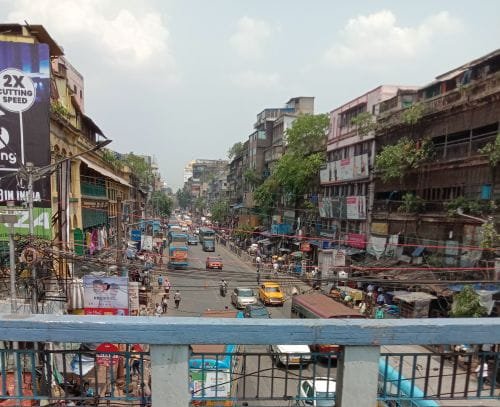
A Street Built Around Kolkata’s Biggest Festival
The name Kalakar itself means “artist” or “craftsman” in Hindi and Bengali, a direct reflection of the street’s historical association with the creative and artistic trades that supplied materials to the city’s festival culture. Durga Puja has always demanded an enormous, fast-moving supply chain — clay, paint, fabric, decorative elements, lighting, and packaging, all needed in bulk and on schedule. Kalakar Street positioned itself right at the centre of that chain, becoming the default destination for pandal organisers, idol makers, and event decorators sourcing materials quickly and at wholesale prices no retail market could match.
Through the decades, the street diversified well beyond pure festival goods, adding kitchenware, ready-made clothing, stationery, and small gifts to its trade. That diversification gave it something most purely seasonal markets lack: year-round relevance, rather than a single frantic peak followed by months of quiet. The street’s history is inseparable from the broader story of Burrabazar itself, which developed during the colonial period as Calcutta’s primary wholesale and trading hub, drawing merchants from across India into its densely packed lanes — a legacy that continues almost unchanged over two centuries later.
Kalakar Street Overview
| Category | Details |
| Location | Burrabazar, Central Kolkata |
| Meaning of name | “Artist/craftsman” in Hindi and Bengali |
| Nearest metro | MG Road (Blue Line) |
| Alternate metro | Central station |
| Adjoining streets | Banstalla Street, Bagri Market, Satyanarayan AC Market |
| Best known for | Festival/decorative materials, Durga Puja supplies, terracotta crafts |
| Also sells | Kitchenware, ready-made clothing, stationery, small gifts, sarees, dress material |
| Peak season | Weeks leading up to Durga Puja (Sept–Oct) |
| Best time to visit | Weekday mornings, 9 AM–1 PM |
| Layout | Narrow, winding lanes (“tree-branch” pattern) |
| Nearby landmark market | Bara Bazar (Burrabazar), one of India’s oldest wholesale markets |
Where Kalakar Street Sits
Kalakar Street runs through Burrabazar, central Kolkata’s historic wholesale district, bordered by Posta, Jorasanko, B.B.D. Bagh, and the Hooghly River, and located near Howrah Bridge along Mahatma Gandhi Road. Mahatma Gandhi Road itself cuts directly through the district, linking Howrah Bridge to Sealdah. Within Burrabazar, Kalakar Street sits alongside other well-known trading pockets — Banstalla Street and Bagri Market among them — each historically specialised into its own micro-market, much like Chinipatti for sugar, Dhotipatti for cotton, or Tulapatti for cotton wool elsewhere in the bazaar. The lanes here are famously narrow and winding, described by regular visitors as resembling tree branches — an atmospheric detail that also means first-time visitors should plan for a slower, more deliberate walk rather than a quick in-and-out shopping trip.
Getting to Kalakar Street
MG Road metro station on the Blue Line is the nearest stop, with Kalakar Street reachable from there by a short walk or auto-rickshaw ride. Central metro station works as a second option nearby, and several sources note both stations sitting within about a five-minute walk of the wider Burrabazar cluster.
Beyond the metro:
- Rail: Howrah Station and Burrabazar Railway Station both count among the nearest landmarks for those arriving by train, useful for shoppers travelling in from outside Kolkata.
- Bus: Multiple city routes run along Rabindra Sarani and the surrounding arterial roads, connecting Burrabazar to most parts of Kolkata.
- Taxi/cab: Yellow taxis and app-based cabs operate throughout the day, though they’ll typically drop you at the edge of the market rather than directly on the narrower lanes.
- Local transport: Auto-rickshaws and cycle rickshaws are genuinely useful once you’re inside Burrabazar — the internal lanes are far too tight for a full-size vehicle to navigate comfortably.
Weekday mornings, roughly 9 AM to 1 PM, are cited as the best window to visit — later in the day and the lanes get considerably harder to move through as wholesale buyers and retail shoppers both pile in.
Shops and What the Street Is Known For
Festival and decorative materials are the street’s signature trade: artificial flowers, thermocol sheets, fabric, ribbons, craft paper, foam sheets, lighting accessories, and finishing materials specifically used for idol-making, all sold at wholesale rates that other Kolkata markets can’t match. In the weeks leading up to Durga Puja specifically, the Kalakar Street area becomes a particular draw — terracotta crafts, decorative items, and artistic supplies here are made and sourced specifically for the puja season, and fabric merchants see their highest volumes of the entire year during this window.
Bastalla Street and Kalakar Street together carry a genuine range of sarees and dress material shops stocking bright colours, embroidered fabrics, and decorative borders — useful to know if bridal shopping is part of your Burrabazar trip, since there’s no fixed pricing here and bargaining is simply expected as part of the transaction. Layered underneath that specialty trade is Burrabazar’s usual general merchandise current: kitchenware, ready-made clothing, stationery, and small gifting products sold to both wholesale and retail buyers from the same dense run of shops. Retailers from across Kolkata and neighbouring districts visit regularly to stock up in bulk, and the sheer density of competing suppliers keeps pricing sharply competitive across almost every category the street touches.
Nearby Areas Worth Visiting Together
Bagri Market, one of Burrabazar’s other major trading hubs, sits close by and is worth combining into the same visit if you’re exploring the wider wholesale district.
Banstalla Street, another well-known Burrabazar lane, adds further variety to a single Burrabazar shopping trip, particularly for sarees and dress material.
Satyanarayan AC Market, a cosy underground market nearby, offers ethnic clothing, fake jewellery, and silver items for those wanting a change of pace from Kalakar Street’s more decorative and general merchandise focus.
Kumortuli, the potters’ colony on the eastern bank of the Hooghly where Durga idols are actually sculpted, connects thematically to Kalakar Street’s role as the materials source for the same festival supply chain — worth visiting together if the idol-making process interests you.
FAQs
Q1. Which metro station is closest to Kalakar Street?
MG Road, on the Blue Line, with Central metro station as a nearby alternative — both roughly a five-minute walk from Burrabazar.
Q2. What is Kalakar Street best known for, and is it only relevant during Durga Puja?
It’s most famous for wholesale festival and decorative materials — terracotta crafts, artificial flowers, fabric, and idol-finishing supplies — but its diversification into general wholesale trade like kitchenware, clothing, and stationery keeps it active and relevant throughout the year, not just during Puja season.
Q3. Can I negotiate prices at Kalakar Street, and is there a fixed rate?
There’s no fixed pricing here, and bargaining is a standard, expected part of shopping — this applies whether you’re buying dress material, decorative items, or general merchandise.
Q4. What’s the best time to visit Kalakar Street to avoid the worst crowds?
Weekday mornings between 9 AM and 1 PM tend to offer noticeably easier movement through the lanes; visiting during the weeks immediately before Durga Puja will mean much heavier footfall regardless of the hour, so factor that in if you’re shopping close to the festival.