 By Saurav Mehra
 Two of the most important stages in Bengali theatre history once stood on this one street. The original Star Theatre opened here on 21 July 1883, and Minerva Theatre followed a decade later in 1893 — both eventually relocating elsewhere, but Beadon Street’s role in launching Bengali commercial theatre is one of the more remarkable, underappreciated chapters of Kolkata’s cultural history. Today it sits quietly at the edge of Hatibagan, one of North Kolkata’s oldest and busiest neighbourhoods, carrying that legacy alongside a genuinely lived-in local market character.
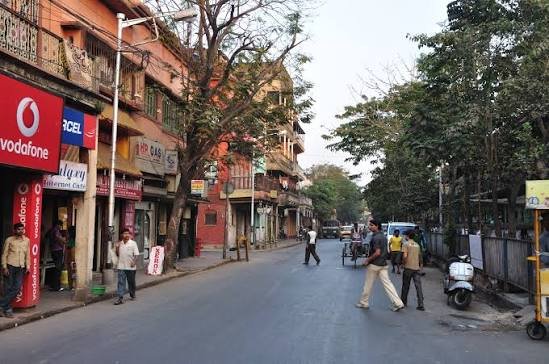
A Street That Launched Bengali Theatre — Twice
Star Theatre’s story begins right here. It opened on Beadon Street on 21 July 1883, and along with the Minerva Theatre, became one of the very first institutions of commercial Bengali theatre in Calcutta. Girish Chandra Ghosh, widely regarded as the father of modern Bengali theatre, was among the first to produce plays here in the 1880s. When ownership of the original venue changed hands, Ghosh and his associates — including Amritalal Basu, Amritalal Mitra, and Dashrathi Roy — left to establish a new Star Theatre nearby at 127 Cornwallis Street (now Bidhan Sarani) in December 1887, staging their first play, “Nashiram,” in May 1888. The original Beadon Street venue kept operating under its new ownership, adopting a different name.
Minerva Theatre followed a similar arc. Established in 1893 by Nagendra Bhusan Mukhopadhyaya at 6 Abhedananda Road (Beadon Street), it was built on the very site where the earlier Great National Theatre had once stood. Its opening production was Macbeth, and it went on to host landmark performances by Girish Chandra Ghosh himself — including, notably, the last spectacular performance of his career. Minerva burned down in a devastating fire in 1922 but was rebuilt and reopened in 1925, resuming its role as one of Kolkata’s central venues for group theatre, intellectual discourse, and freedom-movement-era performances, later hosting iconic productions by Utpal Dutt including Angar and Kallol.
Beadon Street Overview
| Category | Details |
| Location | Hatibagan, North Kolkata |
| Original Star Theatre opened | 21 July 1883, on Beadon Street |
| Star Theatre relocated to | 127 Cornwallis Street (Bidhan Sarani), December 1887 |
| Minerva Theatre established | 1893, at 6 Abhedananda Road (Beadon Street) |
| Minerva rebuilt after fire | Reopened 1925 |
| Nearest metro (Beadon St./Minerva) | Girish Park |
| Nearest metro (relocated Star Theatre) | Shobhabazar Sutanuti / Shyambazar |
| Key intersecting road | Chittaranjan Avenue (starts at Beadon Street crossing, Girish Park) |
| Notable figures associated | Girish Chandra Ghosh, Binodini Dasi, Amritalal Basu |
| Neighbourhood character | Dense residential-commercial, cinema and theatre heritage |
| R.G. Kar Medical College distance | Approx. 1.5 km northeast |
Where Beadon Street Sits
Beadon Street runs through North Kolkata, at the edge of the historic Hatibagan neighbourhood — a bustling hub of cinema halls, theatres, and market stalls that’s stood for well over a century. The street forms a key junction with Chittaranjan Avenue (C.R. Avenue), which begins its entire north-south run right here at the Beadon Street crossing near Girish Park, before continuing south to Esplanade. North of this crossing, Chittaranjan Avenue itself becomes Jatindra Mohan Avenue. The street sits close to Grey Street (now Aurobindo Sarani) and Cornwallis Street (Bidhan Sarani) as well, tying it firmly into North Kolkata’s dense grid of historic thoroughfares.
Getting to Beadon Street
Girish Park metro station, on the Blue Line, is the closest option for reaching Beadon Street and the original Minerva Theatre site directly — the station itself takes its name from Girish Chandra Ghosh, a fitting tribute given the neighbourhood’s theatrical legacy. For the relocated Star Theatre building on Bidhan Sarani, Shobhabazar Sutanuti metro station is the more commonly cited option, roughly a ten-minute walk away, with Shyambazar metro station serving as a further alternative.
Beyond the metro:
- Major road access: Chittaranjan Avenue, running directly through the Beadon Street crossing, carries a major portion of the Kolkata Metro Blue Line beneath it and functions as one of the busiest north-south arterial roads connecting North to Central Kolkata.
- Bus and taxi: Both run heavily along Bidhan Sarani and the surrounding roads, given how central and well-connected this stretch of North Kolkata is.
The area is dense and can get genuinely crowded, particularly around Hatibagan’s market stalls and cinema halls, so walking the final stretch tends to be more practical than trying to drive directly to a specific address on the street.
Shops and What the Street Is Known For
Beadon Street sits at the edge of the broader Hatibagan commercial belt, one of North Kolkata’s oldest and busiest shopping and entertainment districts. Hatibagan Market has operated in this area for more than a century, mixing traditional market stalls with a modern multiplex — cinema and commerce sitting side by side much as they have for generations.
Star Theatre, even in its relocated form on Bidhan Sarani, remains a working cultural venue rather than a museum piece. It functions primarily as a cinema hall today, having been renamed Binodini Theatre in honour of the legendary actress Binodini Dasi, though plays are still staged roughly twice a month, rising to around ten days a month during December and January when Bengali theatre traditionally sees its busiest season. The auditorium is known for excellent acoustics, and its heritage facade has been carefully preserved through restoration even as the interiors were modernised. A remarkable roster of performers has taken this stage over the decades, including Girish Chandra Ghosh, Nati Binodini, Uttam Kumar, Soumitra Chatterjee, and Madhabi Mukherjee — and in 1898, Swami Vivekananda introduced Sister Nivedita to Kolkata right here at the theatre.
Nearby Areas Worth Visiting Together
Hatibagan, the neighbourhood surrounding Beadon Street, is worth exploring in its own right — a century-old market combined with cinema halls and a genuinely lively, unpretentious North Kolkata atmosphere.
Girish Park, right at the street’s edge, anchors the area and gives its name to the nearest metro station, itself named after Girish Chandra Ghosh.
Girish Mancha, in nearby Bagbazar (about a 21-minute walk), is a state-run 909-seat auditorium inaugurated in 1986, also named after Ghosh, and remains one of the city’s most active venues for contemporary Bengali theatre.
Bidhan Sarani (formerly Cornwallis Street), where the relocated Star Theatre stands today, connects further into North Kolkata’s historic core and is a natural continuation of a Beadon Street visit.
FAQs
Q1. Where can I still watch a play associated with Beadon Street’s theatre history?
The relocated Star Theatre (now also called Binodini Theatre) on Bidhan Sarani stages plays roughly twice a month, rising to about ten days a month during December and January. It’s about a ten-minute walk from Shobhabazar Sutanuti metro station.
Q2. Which metro station is closest to Beadon Street itself, versus the theatre venues associated with it?
Girish Park metro station is closest to Beadon Street and the original Minerva Theatre site. For the relocated Star Theatre on nearby Bidhan Sarani, Shobhabazar Sutanuti or Shyambazar metro stations are more commonly used.
Q3. What is Hatibagan Market known for, and is it still active today?
It’s one of Kolkata’s oldest markets, over a century old, combining traditional stalls with a modern multiplex — a genuine mix of shopping and entertainment that remains active and busy in this dense part of North Kolkata.
Q4. Is there a difference between “Star Theatre” and “Binodini Theatre” that I should know about before visiting?
They’re the same venue — the relocated Star Theatre on Bidhan Sarani was renamed Binodini Theatre in honour of actress Binodini Dasi, so both names refer to the same heritage building and its current programming.