 By Saurav Mehra
 T Nagar generates more retail turnover than Connaught Place in Delhi — by some estimates, more than double. Most of that money changes hands on one crowded, 7-metre-wide street. Ranganathan Street doesn’t look like it should carry that kind of weight. It’s narrow, chaotic, and permanently crowded. But ask anyone in Tamil Nadu where to buy a wedding saree, and this is the street they’ll name first.
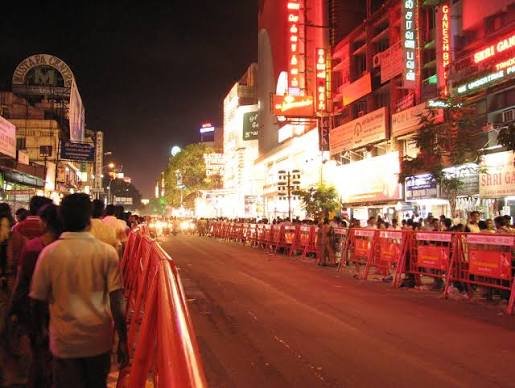
Ranganathan Street: Quick Info
| Detail | Information |
| Location | T Nagar, Chennai (postal code 600017) |
| Connects | Mambalam Railway Station area to Usman Road |
| Nearest metro (current) | Nandanam / Saidapet (Blue Line) — approx. 1–1.5 km |
| Upcoming metro | Panagal Park (Yellow Line, Phase 2) — targeted March 2027 |
| Landmark shops | Saravana Stores, Pothys, Nalli Silks, RmKV, Jeyachandran |
| Best known for | Sarees, textiles, jewellery, household goods |
| Vehicle access | Fully pedestrianised |
| Peak season | Diwali, Pongal, and wedding season |
Where Ranganathan Street Sits in Chennai
Ranganathan Street runs through the heart of T Nagar, one of Chennai’s oldest planned residential-turned-commercial neighbourhoods, roughly 10 km south of the city centre. The street connects the area near Mambalam Railway Station to Usman Road, feeding directly into Pondy Bazaar — T Nagar’s other major shopping stretch — at its northern end. Panagal Park, the green space and traffic circle that gives the area its bearings, sits right alongside it.
The street itself is short and narrow by any standard — barely seven metres wide — but it’s flanked on both sides by four- and five-storey buildings, almost every floor of which is retail space in some form.
Getting to Ranganathan Street
This is where things get interesting, because T Nagar’s metro story is genuinely still being written. Right now, there’s no metro station sitting directly on Ranganathan Street. The closest operational stations — Nandanam and Saidapet, both on the Blue Line — sit roughly a kilometre to a kilometre and a half away, meaning a ten-to-fifteen-minute walk or a short auto ride once you factor in T Nagar’s traffic.
That’s changing. Panagal Park metro station, under construction as part of Chennai Metro’s Phase 2 Yellow Line, will sit directly in T Nagar and is designed with five separate entry points specifically to handle the crowd this area pulls in. Officials have targeted March 2027 for the Kodambakkam-to-Panagal Park underground stretch to open, which would give Ranganathan Street direct metro access for the first time. Until then, most people rely on:
- Train: Mambalam Railway Station sits almost at the street’s doorstep — under a kilometre away — and handles a steady stream of suburban EMU and MEMU services.
- Bus: T Nagar Bus Terminus, one of the busiest in the city, connects to virtually every part of Chennai.
- Auto/cab: Drops happen at the edge of the pedestrianised zone; you’ll cover the rest on foot regardless.
Driving here yourself isn’t really an option worth considering. Parking is scarce, the street is fully pedestrianised, and traffic around T Nagar backs up hard during peak shopping hours. Train or bus, followed by a walk, is genuinely the faster route more often than not.
Shops and What the Street Is Known For
Textiles and jewellery dominate. Saravana Stores, founded in 1969, anchors the street and has grown from a modest textile outlet into a retail name recognised across South India — five and six floors deep in some locations, selling everything from sarees to stationery to safety pins. Pothys, running for close to ninety years, and Nalli Silks are the other two names that come up in nearly every conversation about buying a Kanchipuram silk saree in Chennai.
Beyond the big three, the street carries dozens of smaller multi-storey showrooms — RmKV, Jeyachandran Textile and Jewellery, Rathna Stores — alongside compact, family-run stalls squeezed into whatever space is left. Jewellery retail spills over heavily into adjoining Usman Road, where GRT, Joyalukkas, and Kalyan Jewellers run some of their flagship stores.
It’s not purely a saree-and-gold destination, though. Ground-level stalls sell fresh vegetables, fruit, and flowers through the day, and electronics shops selling phones and accessories at below-MRP prices have carved out their own corner of the street’s identity. During Diwali and wedding season, shops here stay open well into the night, and single-day sales figures across the street are estimated to run into several crores of rupees.
Nearby Areas Worth Combining With Your Visit
⇒ Pondy Bazaar, just north along Usman Road, is T Nagar’s other major shopping stretch and home to Chennai’s first pedestrian plaza, opened in 2019. It leans more toward footwear, accessories, and casual apparel — a good contrast if Ranganathan Street’s saree shops aren’t what you’re after.
⇒ Panagal Park sits right beside the street and works as a natural landmark and a rare patch of green in an otherwise concrete-heavy neighbourhood. It’s also where the upcoming metro station takes its name from.
⇒ Usman Road, technically an extension of the same shopping district, houses T Nagar’s densest cluster of jewellery showrooms and is often where saree shopping continues once Ranganathan Street’s crowds get overwhelming.
⇒ Mambalam, the residential neighbourhood surrounding the railway station, gives a quieter, more local feel once you step a couple of streets back from the commercial chaos.
FAQs
Q1. Is there a metro station right on Ranganathan Street?
Not yet. The nearest operational stations, Nandanam and Saidapet, are about a kilometre away. Panagal Park metro station, under construction, will sit directly in T Nagar and is expected to open around March 2027.
Q2. Can I drive to Ranganathan Street?
It’s not advisable. The street is fully pedestrianised, parking nearby is limited, and traffic in T Nagar gets heavy during peak hours. Train or bus followed by a short walk works better.
Q3. What is Ranganathan Street best known for?
Sarees, textiles, and jewellery, led by big names like Saravana Stores, Pothys, and Nalli Silks, alongside dozens of smaller shops selling household goods and everyday items.
Q4. When is the street most crowded?
Diwali and wedding season see the heaviest footfall, though the street stays busy on ordinary days too. Early morning tends to be the calmest window for shopping.
Q5. How do I get from Ranganathan Street to Pondy Bazaar?
They’re directly connected — Ranganathan Street feeds into Usman Road at its northern end, and Pondy Bazaar sits just past that junction, an easy walk away.